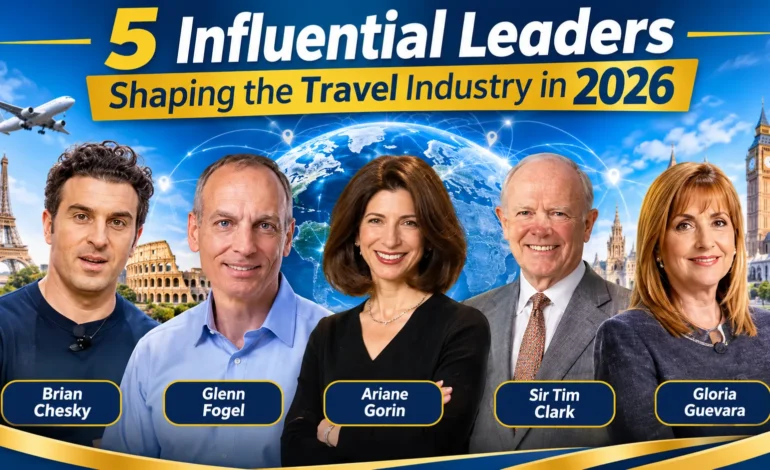
5 Influential Leaders Shaping the Travel Industry in 2026
Travel and tourism are among the world’s most important economic sectors. They connect countries, support millions of jobs, encourage investment, and allow people to experience different cultures and destinations.
According to the World Travel & Tourism Council (WTTC), travel and tourism are forecast to contribute approximately $12 trillion to the global economy in 2026, representing around 9.9% of global GDP. The sector is also expected to support approximately 376 million jobs worldwide, or roughly one in every nine jobs. These estimates come from the WTTC’s 2026 Economic Impact Research.
Behind this large industry are executives and industry leaders whose decisions influence how people book accommodation, purchase airline tickets, discover destinations, and organize their journeys. Some lead global travel platforms, while others shape aviation networks or represent the interests of tourism businesses around the world.
This article highlights five influential personalities shaping the travel industry in 2026. They represent different areas of the sector: home-sharing, online travel booking, travel distribution technology, international aviation, and tourism policy. The selection considers their leadership positions, organizational reach, business decisions, and influence on industry developments. It is an editorial selection, not a ranking by wealth or personal popularity.
1. Brian Chesky
Role: Co-founder and CEO, Airbnb
Sphere of influence: Accommodation, travel experiences, and digital trip planning
Brian Chesky is one of the most recognizable entrepreneurs in the modern travel industry. He co-founded Airbnb in 2007 with Joe Gebbia and Nathan Blecharczyk. The original idea was to allow people to rent available space in their homes to travelers who wanted alternatives to traditional hotels.
That simple concept developed into a global accommodation marketplace. Airbnb now operates across more than 220 countries and regions, with over 5.5 million hosts and more than 2.5 billion guest arrivals recorded throughout its history. Chesky continues to serve as the company’s co-founder and chief executive officer.
His education in industrial design at the Rhode Island School of Design influenced the company’s emphasis on product experience, visual presentation, and customer needs. He has also become associated with the idea of founder mode, a hands-on approach to leadership that encourages company founders to remain closely involved in important decisions.
Airbnb’s strategy has expanded beyond accommodation. The company introduced services and experiences alongside its redesigned app in May 2025, giving travelers more ways to discover activities and services through the platform.
Artificial intelligence has become another major part of Chesky’s plans. Airbnb’s November 2026 third-quarter results showed that approximately 40% of all customer-support issues were resolved without a human agent during the quarter, up from one-third in the previous quarter. Its AI assistant was also available in more than 50 languages.
Chesky has discussed using AI to accelerate product development. In August 2026, he told Fortune that AI was writing approximately 60% of Airbnb’s code. This reflects the company’s effort to use the technology in both its internal operations and customer-facing services.
Airbnb is also developing a specialized AI travel agent designed to help users explore accommodation, compare options, and organize trips. According to the company’s November 2026 announcement, it plans to begin rolling out this experience in the first half of 2027.
These developments show how Chesky wants Airbnb to become more than a place to reserve accommodation. The company is attempting to make its platform useful across more stages of the travel journey.
2. Glenn Fogel
Role: President and CEO, Booking Holdings
Sphere of influence: Online bookings, accommodation distribution, and travel technology
Glenn Fogel leads Booking Holdings, one of the world’s largest online travel companies. Its portfolio includes Booking.com, Priceline, Agoda, KAYAK, and OpenTable, giving the group a significant presence across several parts of the travel and hospitality market.
Fogel became president and CEO of Booking Holdings in January 2017. Before taking the position, he held senior responsibilities in corporate development, worldwide strategy, and planning. He also played a role in major acquisitions that helped expand the company’s international reach.
Booking Holdings connects travelers with accommodation providers, airlines, rental car companies, restaurants, and other travel services. Its platforms allow customers to compare options and make reservations through digital channels.
Fogel’s influence comes from managing a business that sits between travelers and a large network of service providers. Decisions about search technology, booking processes, pricing tools, and customer support can affect how millions of people organize their trips.
Artificial intelligence is becoming an important part of the company’s strategy. Booking Holdings is developing AI-powered tools to help users discover travel options, compare choices, and complete reservations.
Its November 2026 third-quarter earnings discussion provided an indication of how these tools are performing. The company reported that users of its AI assistants at Priceline and Agoda converted at approximately twice the rate of non-users. Agoda users of its assistant also recorded average booking values around 20% higher than those of non-users.
However, external AI referrals remain relatively small. Booking Holdings said referrals from large language models still accounted for significantly less than 1% of Booking.com’s room nights. This distinction matters because AI can influence how travelers discover destinations without necessarily replacing established booking platforms.
Fogel’s challenge is to ensure that Booking Holdings remains useful as travel discovery changes. The company must combine new technology with the dependable booking systems, customer support, and supplier relationships that travelers expect.
3. Ariane Gorin
Role: CEO, Expedia Group
Sphere of influence: Online travel brands, business-to-business distribution, and travel technology
Ariane Gorin became CEO of Expedia Group on May 13, 2024. She joined the company in 2013 after spending approximately a decade at Microsoft. Before becoming CEO, she held several senior positions and led Expedia’s business-to-business operations.
Her professional background includes technology, international sales, distribution, and business development. This experience is relevant to Expedia because the company operates both consumer-facing travel websites and technology services used by other businesses.
Expedia Group owns recognizable travel brands, including Expedia, Hotels.com, and Vrbo. Its business-to-business division also provides travel inventory and technology to companies that want to offer booking services to their own customers.
This business model gives Expedia influence beyond its consumer websites. Hotels, travel agencies, financial institutions, and other organizations can use its systems to access accommodation, flights, and other travel products without developing an entire global booking infrastructure themselves.
The scale of this operation was highlighted in May 2026, when Expedia Group said its B2B platform served approximately 75,000 partners and 200,000 travel advisors. The company also reported processing around 21 billion API calls each day, based on its internal 2025 data. An API allows different software systems to exchange information, making it possible for travel businesses to connect their services with Expedia’s platform.
Artificial intelligence is another part of Gorin’s strategy. Expedia has been introducing AI-powered tools and partnerships to make travel discovery and distribution more efficient. These developments could help travelers compare options while allowing business partners to offer more connected services.
Gorin also joined the board of LVMH in April 2026, following the approval of her appointment at the group’s annual general meeting. The appointment reflects her experience in managing large international businesses and consumer-focused technology operations.
Her influence is therefore not limited to Expedia’s own booking websites. Decisions made under her leadership can affect the technology and travel inventory that other companies use to serve their customers.
4. Sir Tim Clark
Role: President, Emirates
Sphere of influence: International aviation, long-haul travel, and Dubai’s global airline hub
Sir Tim Clark is a prominent figure in international aviation. He joined Emirates in 1985, during the airline’s early development, and became its president in 2003.
Over the years, Clark has helped shape Emirates into a major international airline. Its business model connects passengers across continents through Dubai, making the city an important transfer hub for long-distance travel.
He has been particularly influential in developing Emirates’ long-haul network and premium passenger experience. His leadership has also involved major fleet decisions and relationships with aircraft manufacturers, including Airbus and Boeing.
However, 2026 has presented significant operational challenges. Geopolitical tensions and regional airspace restrictions disrupted airline operations across the Middle East. In April, Clark said Emirates was operating at more than 65% of its normal capacity as the airline responded to the disruption.
The airline gradually restored its operations. In September 2026, Emirates reported that it was operating at approximately 93% of its pre-disruption capacity. Its later half-year report separately stated that it had restored 91% of its pre-disruption network by September 30. These are different measures: one refers to operating capacity, while the other describes the network of destinations and services.
Emirates has also continued investing in its passenger experience. Its major cabin retrofit programme covers 219 aircraft, including Airbus A380s and Boeing 777s. By July 2026, the airline had completed refurbishment work on 100 aircraft, with upgrades covering cabin interiors and passenger facilities.
Clark’s future at Emirates has also attracted attention. In November 2026, he said he may consider retirement in 2028 if the airline reaches a stable position and he feels comfortable leaving it in the hands of his team. This is a possibility he has discussed, not a confirmed retirement date.
His long career illustrates that airline leadership involves much more than operating aircraft. It requires managing international relationships, responding to unexpected disruptions, investing in passenger services, and planning for long-term growth.
5. Gloria Guevara
Role: President and CEO, World Travel & Tourism Council (WTTC)
Sphere of influence: Tourism policy, international cooperation, and industry investment
Gloria Guevara is an influential figure in global tourism policy. As president and CEO of the World Travel & Tourism Council, she represents the interests of the private travel and tourism sector and works with businesses and governments on major industry priorities.
Her experience includes both public service and private-sector leadership. She previously served as Mexico’s secretary of tourism and held senior advisory roles connected to Saudi Arabia’s tourism sector.
Guevara also led WTTC from 2017 to 2021. After working in other advisory and leadership positions, she returned to the organization. WTTC officially appointed her president and CEO again on January 19, 2026.
Her influence comes partly from the organization’s research and industry representation. WTTC publishes economic impact studies examining tourism’s contribution to national economies, employment, investment, and business activity.
Its May 2026 forecast estimated that travel and tourism would contribute approximately $12 trillion to global GDP during the year. It also projected that the sector would support 376 million jobs worldwide, equivalent to around one in every nine jobs.
Another WTTC report, published in August 2026, found that global investment in travel and tourism exceeded $1 trillion in 2025, growing by 8.5% compared with the previous year. The research highlighted the importance of investment in infrastructure, destinations, connectivity, and business development.
These figures help Guevara and WTTC make the economic case for tourism. They provide governments and businesses with information that can support decisions about infrastructure, investment, travel facilitation, and destination development.
Her role is different from that of a company CEO. Rather than managing an airline or booking platform, she works to influence the wider environment in which travel businesses operate.
Frequently Asked Questions
Who are the most influential leaders in the travel industry in 2026?
Influential leaders include Brian Chesky of Airbnb, Glenn Fogel of Booking Holdings, Ariane Gorin of Expedia Group, Sir Tim Clark of Emirates, and Gloria Guevara of WTTC. They represent different areas of the industry, including accommodation, online bookings, travel technology, aviation, and tourism policy.
Is this a ranked list of the most influential travel personalities?
No. The five individuals are selected to represent different parts of the travel industry. Their order does not indicate a ranking based on wealth, company size, or personal popularity.
Who is the CEO of Airbnb in 2026?
Brian Chesky is the co-founder and CEO of Airbnb. He helped establish the company in 2007 and continues to lead its overall strategy and development.
Who runs Booking Holdings?
Glenn Fogel is the president and CEO of Booking Holdings. He has held the position since January 2017 and oversees the group behind brands such as Booking.com, Priceline, Agoda, and KAYAK.
Who is the CEO of Expedia Group in 2026?
Ariane Gorin is the CEO of Expedia Group. She assumed the position on May 13, 2024, after holding several senior leadership roles within the company.
Who is the president of Emirates?
Sir Tim Clark is the president of Emirates. He joined the airline in 1985 and became its president in 2003.
What does the World Travel & Tourism Council do?
The WTTC represents the global private travel and tourism sector. It works with businesses and governments and publishes research on tourism’s economic contribution, employment, investment, and development.
How is artificial intelligence changing the travel industry?
Artificial intelligence is influencing travel through customer support, personalized recommendations, trip planning, search tools, and booking assistance. Companies such as Airbnb, Booking Holdings, and Expedia are investing in these technologies to help travelers discover options and arrange trips more efficiently.
Final Thoughts
The travel industry is shaped by more than destinations, hotels, and passenger numbers. It also depends on the people making decisions about technology, accommodation, airline networks, digital bookings, and tourism policy.
Brian Chesky is expanding the role of home-sharing platforms. Glenn Fogel is guiding a major online travel business through the growth of AI-powered booking tools. Ariane Gorin is developing Expedia’s consumer and business technology operations. Sir Tim Clark continues to shape international aviation, while Gloria Guevara represents the industry’s wider economic and policy interests.
Their responsibilities are different, but each contributes to how travel businesses respond to changing customer expectations, new technology, and global challenges. As artificial intelligence, international connectivity, and travel demand continue to evolve, the decisions made by these leaders will help shape the industry’s next chapter. For travelers, the most important outcome should be a more connected, accessible, and reliable travel experience.
Find this list interesting? Magazines Insights brings readers more stories on the founders shaping the tech future.