Top 5 Women Entrepreneurs Breaking Business Barriers in 2026
Women are building influential businesses across industries once dominated by men. From construction supplies and healthcare technology to fintech and beauty, female entrepreneurs are changing how companies grow and compete.
The progress is visible in wealth rankings. According to Forbes’ 2026 list of America’s Richest Self-Made Women, a record 43 women made the list as self-made billionaires. That is up from 38 in the previous year.
However, greater visibility does not mean equal access to business opportunities. The PitchBook-NVCA Venture Monitor reported that companies with all-female founding teams received just 1.1% of total U.S. venture capital investment in 2025. This highlights the funding challenges many women founders continue to face.
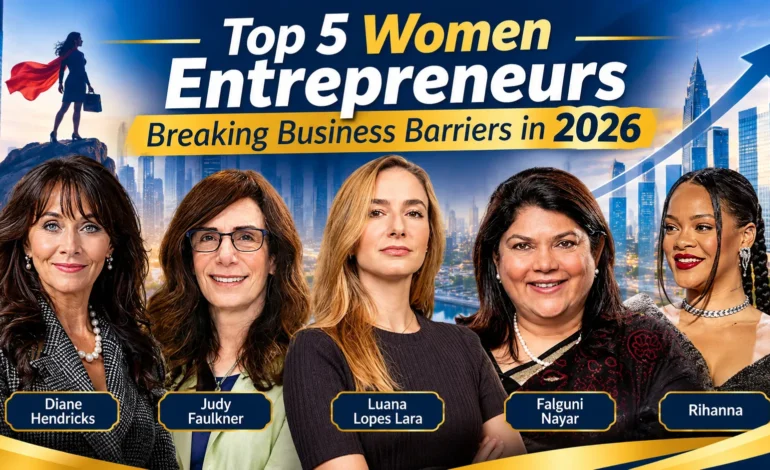
The five entrepreneurs below have built successful businesses in very different fields. Some entered established industries, while others helped create entirely new markets. This is not a strict ranking. It is a look at five women whose business journeys offer valuable lessons in leadership, innovation, and persistence.
Diane Hendricks: Building an Empire in the Construction Supply Industry
Company: ABC Supply
Industry: Building materials distribution
The barrier: Succeeding in a traditionally male-dominated business sector.
Diane Hendricks is the co-founder of ABC Supply, one of North America’s largest wholesale distributors of roofing and other building materials. She established the company in 1982 with her late husband, Ken Hendricks, in Beloit, Wisconsin.
Their business began with the acquisition of three building supply centers. Over time, ABC Supply expanded through new locations and acquisitions. It now operates more than 1,000 locations across the United States and Canada.
After Ken Hendricks died in 2007, Diane continued leading the business. Her leadership helped the company maintain its position as a major supplier to professional contractors.
In June 2026, Forbes named her America’s richest self-made woman for the ninth consecutive year. The publication estimated her fortune at approximately $21.7 billion. Her wealth comes primarily from building supplies, along with investments in other businesses and industries.
Her achievement is particularly notable because she built her fortune in a practical industry that receives less public attention than technology, entertainment, or fashion.
Judy Faulkner: Turning a Basement Startup Into a Healthcare Technology Giant
Company: Epic Systems
Industry: Healthcare software
The barrier: Building a major technology company in a sector where women have historically had limited representation.
Judy Faulkner founded Epic Systems in 1979. Originally called Human Services Computing, the company began in a basement in Wisconsin with approximately $70,000 in startup funding.
Faulkner was a computer programmer who saw an opportunity to improve how healthcare organizations managed patient information. She focused on developing software that could help hospitals organize medical records and coordinate patient care.
That early idea grew into one of the most influential healthcare software companies in the United States. Epic provides electronic health record systems used by major medical centers, including Johns Hopkins and Mayo Clinic. Its software supports medical records for hundreds of millions of patients.
Forbes ranked Faulkner third on its 2026 list of America’s richest self-made women, estimating her wealth at approximately $9.6 billion. She remains Epic’s founder and CEO.
Faulkner has also made a major philanthropic commitment. She signed the Giving Pledge and has agreed to give away 99% of her wealth to charitable causes through her foundation.
Unlike many technology startups, Epic has grown without relying on venture capital funding or frequent acquisitions. Its development has largely focused on building software internally and maintaining long-term relationships with healthcare organizations.
Luana Lopes Lara: From Professional Ballet to a Billion-Dollar Fintech Startup
Company: Kalshi
Industry: Financial technology and prediction markets
The barrier: Entering a competitive technology sector and building a company around a relatively new financial market.
Luana Lopes Lara’s journey to entrepreneurship took an unusual route. Before becoming a technology founder, she trained in classical ballet in Brazil and eventually performed professionally in Austria.
She later studied computer science at the Massachusetts Institute of Technology (MIT). There, she met Tarek Mansour, who would become her business partner.
Together, they co-founded Kalshi, a prediction market platform that allows users to trade contracts based on the outcomes of real-world events. These markets cover subjects such as economic indicators, politics, sports, and other developments.
Building Kalshi was not an easy process. The company faced regulatory challenges as it worked to establish prediction markets as a regulated financial product in the United States. It received approval from the Commodity Futures Trading Commission in 2020.
In December 2025, Kalshi raised $1 billion at an $11 billion valuation. The funding helped Lopes Lara become the world’s youngest self-made woman billionaire at age 29.
The company’s growth continued in 2026. Forbes reported that Kalshi’s valuation reached $22 billion following another $1 billion funding round in May. Its estimate of Lopes Lara’s fortune rose to approximately $2.6 billion.
She serves as the company’s co-founder and chief operating officer. Her rise also brought greater attention to prediction markets, a sector that continues to face debate over regulation, consumer protection, and the boundaries between financial trading and gambling.
Falguni Nayar: Proving It Is Never Too Late to Become an Entrepreneur
Company: Nykaa
Industry: Beauty, fashion, and retail
The barrier: Challenging assumptions about age and the ideal time to start a business.
Falguni Nayar built her career in investment banking before becoming one of India’s best-known business founders. She spent 18 years at Kotak Mahindra Capital, where she gained extensive experience in finance and corporate strategy.
In 2012, at around 50 years old, she left her established banking career to launch Nykaa. Her idea was to create an online destination where customers could discover and purchase authentic beauty products.
The business gradually expanded beyond online retail. Nykaa developed physical stores, introduced fashion products, and launched its own consumer brands under the House of Nykaa name.
This combination of digital retail and physical stores helped the company build a strong position in India’s beauty and lifestyle market.
Nykaa’s financial performance also reflects its expansion. In fiscal year 2026, the company reported revenue of approximately ₹10,022 crore, crossing the ₹10,000 crore milestone. Its reported profit after tax reached ₹204 crore, while EBITDA rose to ₹752 crore.
In February 2026, Nayar was reappointed as executive chairperson, managing director, and CEO for another five-year term. At its June 2026 investor event, Nykaa also outlined an ambition to build a beauty and lifestyle business with more than $5 billion in gross merchandise value by fiscal year 2030.
Nayar’s story challenges the idea that entrepreneurship belongs mainly to younger founders. Her experience in investment banking gave her financial knowledge that became useful when building and expanding the company.
Rihanna: Turning Representation Into a Global Beauty Business
Companies: Fenty Beauty and Savage X Fenty
Industry: Beauty and fashion
The barrier: Addressing customers and body types that traditional beauty and fashion brands often overlooked.
Rihanna is widely recognized as a global music star, but her business success has also made her a major entrepreneur. Her most significant commercial achievement has been building brands that connect with customers through inclusion and representation.
In 2017, she launched Fenty Beauty in partnership with LVMH. The brand entered the cosmetics market with a foundation range of 40 shades, helping draw attention to the lack of inclusive shade options across the beauty industry.
The launch received significant attention because customers with different skin tones had often struggled to find suitable foundation products. Fenty Beauty positioned inclusivity as a central part of its identity rather than a minor product feature.
In 2018, Rihanna expanded into fashion with Savage X Fenty, a lingerie brand known for offering a broad range of sizes and styles. The company developed a strong identity around body confidence and representation.
Her business journey has also experienced challenges. Forbes estimated her fortune at approximately $1 billion on its 2026 richest self-made women list, lower than its earlier estimates. Its reporting has linked previous changes in her estimated wealth to business performance, including relatively flat Fenty Beauty sales and leadership changes at Savage X Fenty.
These figures are estimates rather than audited statements of her personal finances. Nevertheless, her brands demonstrate how a clear customer-focused identity can help a business stand out in competitive markets.
Frequently Asked Questions
Who is the richest self-made woman in America in 2026?
Diane Hendricks, co-founder of ABC Supply, topped Forbes’ 2026 list of America’s richest self-made women. Forbes estimated her fortune at approximately $21.7 billion.
Who is the world’s youngest self-made woman billionaire?
Luana Lopes Lara became the world’s youngest self-made woman billionaire in December 2025 at age 29. She co-founded Kalshi, a prediction market company.
How many self-made women billionaires are there in the United States in 2026?
Forbes’ 2026 ranking includes a record 43 self-made women billionaires, compared with 38 in the previous year.
What is Epic Systems, and who founded it?
Epic Systems is a healthcare software company founded by Judy Faulkner in 1979. It develops electronic health record systems used by hospitals and healthcare organizations.
Who founded Nykaa?
Falguni Nayar founded Nykaa in 2012 after spending 18 years in investment banking at Kotak Mahindra Capital.
Is this list ranked by net worth?
No. The five entrepreneurs are presented to highlight their business achievements and different approaches to overcoming barriers. Their order does not represent a ranking by wealth or business performance.
Find this list interesting? Magazines Insights brings readers more stories on the founders shaping the tech future.