Top 5 Women Shaping the Technology Industry in 2026
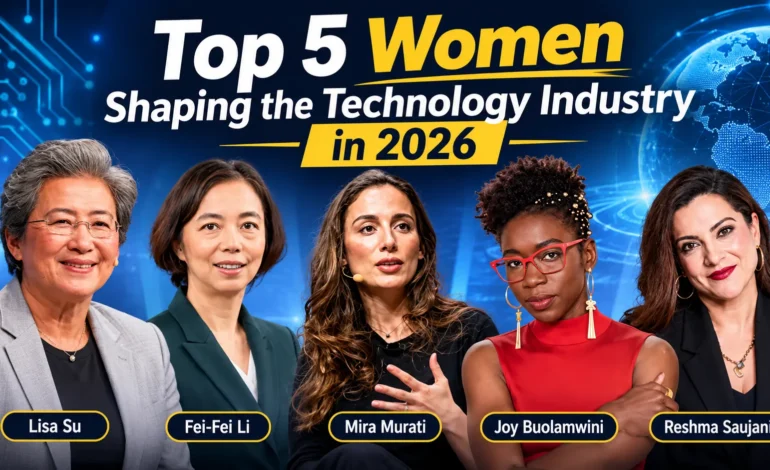
Technology is evolving rapidly, and the people shaping its future come from different backgrounds and disciplines. Women are leading major chip companies, advancing artificial intelligence, challenging algorithmic bias, and creating opportunities for the next generation.
Their influence extends beyond company leadership. Some are developing the infrastructure behind modern AI. Others are asking how machines should understand the world or whether automated systems treat people fairly. Some are working to ensure more girls have the skills and confidence to enter technology.
This list highlights five women making a significant impact in different areas of the industry. It is not a strict ranking. Each represents a different kind of influence, from engineering and research to entrepreneurship, accountability, and education.
The profiles reflect developments reported through November 12, 2026.
Lisa Su : The Engineer Leading AMD’s AI Ambitions
Role: Chair and CEO of Advanced Micro Devices (AMD)
Lisa Su has become one of the most influential executives in the semiconductor industry. As chair and CEO of AMD, she leads a company whose processors and graphics technologies power computers, gaming systems, cloud infrastructure, and artificial intelligence.
Born in Tainan, Taiwan, Su moved to the United States with her family as a young child. She grew up in New York and developed an early interest in science and engineering. She later attended the Massachusetts Institute of Technology, earning bachelor’s, master’s, and doctoral degrees in electrical engineering.
Before joining AMD, Su held engineering and leadership positions at Texas Instruments, IBM, and Freescale Semiconductor. She joined AMD in 2012 and became its president and CEO in October 2014.
At the time, AMD faced serious competitive and financial challenges. Su focused on product development, engineering execution, and strengthening the company’s position in high-performance computing. The company subsequently expanded its presence in server processors, graphics, and data-center technology.
AMD’s trillion-dollar milestone
One of the most notable moments in Su’s leadership came in September 2026. AMD briefly crossed a $1 trillion market capitalization, becoming the first company led by a woman to reach that valuation milestone.
The achievement was significant, although the company’s market value later moved below the trillion-dollar threshold. It remains an important moment in the history of women in corporate technology leadership.
Fei-Fei Li : The AI Pioneer Exploring Spatial Intelligence
Role: Co-founder and CEO of World Labs; named to become AMD’s executive vice president and chief scientist after its proposed acquisition closes
Fei-Fei Li is a leading researcher in artificial intelligence and computer vision. She is widely recognized for creating ImageNet, a large-scale image dataset that helped advance computer vision research and contributed to the development of modern deep learning.
Li earned her undergraduate degree in physics from Princeton University and her doctorate in electrical engineering from the California Institute of Technology. She joined Stanford University in 2009 and later directed the Stanford Artificial Intelligence Laboratory from 2013 to 2018.
She also served as vice president at Google and chief scientist of AI and machine learning at Google Cloud. Her academic work and industry experience have made her an influential voice in discussions about AI research, human-centered technology, and responsible development.
From ImageNet to spatial intelligence
In 2024, Li co-founded World Labs, a company focused on developing what it calls spatial intelligence.
The idea goes beyond systems that primarily process language or recognize objects in pictures. Spatial intelligence aims to help AI systems understand three-dimensional environments, relationships between objects, and aspects of the physical world.
World Labs introduced Marble, a product that generates persistent, navigable 3D environments from inputs such as images, videos, and text. The World Lab announced a $1 billion funding round in February 2026, reflecting investor interest in this emerging area of AI.
In September 2026, AMD announced a proposed all-stock acquisition of World Labs valued at approximately $8.2 billion. The deal is expected to bring Li into AMD as executive vice president and chief scientist, reporting to Lisa Su.
Important: The acquisition was announced as a proposed transaction and remained subject to regulatory approvals and other closing conditions as of November 12, 2026. Li’s future AMD position should therefore not be described as an appointment that has already taken effect.
Readers can consult AMD’s official World Labs acquisition announcement for the transaction’s terms and expected timeline.
Mira Murati : Building a New Direction for Artificial Intelligence
Role: Co-founder and CEO of Thinking Machines Lab
Mira Murati became widely known through her leadership at OpenAI, where she served as chief technology officer during the launch and expansion of several prominent AI products.
She worked on products and research that helped bring generative AI into everyday conversations. Her experience placed her at the center of one of the most important periods in the commercial development of artificial intelligence.
Murati left OpenAI in September 2024. In February 2025, she introduced Thinking Machines Lab, a new AI company focused on developing advanced systems that people and organizations can understand, customize, and use collaboratively.
Funding, NVIDIA partnership, and Inkling
Thinking Machines Lab attracted considerable attention before publicly releasing its first model. In July 2025, the company closed a $2 billion seed funding round at a reported $12 billion valuation.
In March 2026, it announced a major strategic partnership with NVIDIA. The agreement includes a significant NVIDIA investment and a multi-year plan to deploy at least one gigawatt of next-generation computing systems. The infrastructure is intended to support the company’s model training and AI platforms.
The company introduced its first major model, Inkling, in July 2026. It describes Inkling as an open-weights model that works with text, images, and audio. The release gives developers access to model weights, allowing them to explore and adapt the technology.
Thinking Machines also offers Tinker, a platform designed to help users customize and fine-tune models. In November 2026, the company continued expanding its model family with another Inkling-related release.
The company has also experienced significant staff changes. Several co-founders and early employees departed during 2026, including researchers who returned to OpenAI. These developments highlight the intense competition for experienced AI researchers and engineers.
Joy Buolamwini : Challenging Bias in Artificial Intelligence
Role: Founder of the Algorithmic Justice League
Joy Buolamwini is a computer scientist, researcher, and advocate for accountability in artificial intelligence. Her work examines how automated systems can produce unfair outcomes when their design or training data fails to represent different groups of people.
Her interest in algorithmic bias grew from a personal experience during a graduate school project. A facial analysis system struggled to detect her face. She discovered that wearing a white mask allowed the software to recognize her.
That experience raised a larger question: if a technology cannot reliably recognize everyone, what happens when organizations use it to make important decisions?
From research to public advocacy
Buolamwini’s research helped bring attention to racial and gender disparities in commercial facial analysis systems. Her collaboration with researcher Timnit Gebru on the Gender Shades study examined differences in the accuracy of gender classification systems across demographic groups.
In 2016, Buolamwini founded the Algorithmic Justice League (AJL). The organization uses research, education, art, and advocacy to raise awareness about algorithmic harms and encourage greater accountability in technology.
The AJL has helped bring conversations about facial recognition, automated decision-making, and AI fairness to a wider audience. Its work is particularly relevant as governments and businesses introduce automated systems into areas such as hiring, policing, finance, and public services.
Buolamwini is also the author of Unmasking AI, a book exploring algorithmic bias and the people affected by it.
In November 2025, she was elected to the board of the NAACP Legal Defense and Educational Fund. The appointment brought her expertise in AI accountability into a major civil rights organization.
The Algorithmic Justice League’s official background and mission explain how her personal experience helped inspire the organization’s work.
Reshma Saujani : Expanding Opportunities for Girls and Women in Technology
Role: Founder of Girls Who Code and founder and CEO of Moms First
Reshma Saujani approaches the technology industry’s gender gap from a different direction. Rather than leading a semiconductor company or developing AI models, she has focused on the educational and economic barriers that affect women’s participation in the workforce.
Saujani trained as a lawyer and entered public life through politics. During her 2010 campaign for Congress, she visited schools and noticed the lack of girls in computer science classrooms.
That experience helped inspire her next major project.
Building Girls Who Code
In 2012, Saujani founded Girls Who Code, a nonprofit organization created to help close the gender gap in technology.
The organization provides coding education, clubs, programs, and other learning opportunities designed to encourage girls to explore computer science. Its goal is not only to teach technical skills but also to help young people see themselves as future programmers, engineers, and technology leaders.
Saujani led Girls Who Code as its CEO for nearly nine years. In 2021, she passed the leadership role to Tarika Barrett, allowing the organization to continue under new management.
She later founded Moms First, an organization focused on issues such as affordable childcare, paid family leave, and the economic challenges facing working mothers.
Although Moms First is not a technology organization, its work connects to a wider question about women’s careers: how can industries attract and retain talented women if workplace structures make it difficult for them to remain employed and advance?
Named in 2026
Saujani received further recognition in 2026 when TIME named her one of its Women of the Year. She also delivered the 2026 commencement address at Olin College of Engineering.
Her 2023 Smith College commencement speech about imposter syndrome attracted significant attention. In it, she challenged the idea that women simply need more confidence to succeed. She also highlighted the structural and cultural barriers that can keep qualified women out of influential positions.
Frequently Asked Questions
Who are five influential women shaping technology in 2026?
Five influential women include Lisa Su, Fei-Fei Li, Mira Murati, Joy Buolamwini, and Reshma Saujani. They represent different areas, including semiconductors, AI research, AI entrepreneurship, algorithmic accountability, and technology education.
Why is Lisa Su important to the technology industry?
Lisa Su leads AMD and has helped strengthen its position in high-performance computing and AI infrastructure. AMD also briefly crossed a $1 trillion market capitalization in September 2026 under her leadership.
What is Fei-Fei Li known for?
Fei-Fei Li is known for creating ImageNet, a major image dataset that contributed to advances in computer vision and deep learning. She later co-founded World Labs to develop spatial intelligence technology.
What is Thinking Machines Lab?
Thinking Machines Lab is an AI company co-founded and led by Mira Murati. It develops AI models and tools, including its open-weights Inkling model and Tinker customization platform.
What does the Algorithmic Justice League do?
The Algorithmic Justice League is an organization founded by Joy Buolamwini. It raises awareness about bias in artificial intelligence and advocates for fairer, more accountable automated systems.
Why did Reshma Saujani create Girls Who Code?
Saujani founded Girls Who Code in 2012 after noticing the gender gap in computer science classrooms. The nonprofit helps girls develop coding skills and explore opportunities in technology.
How can people support women in technology?
People can support women in technology by mentoring students and professionals, encouraging girls to study computer science, supporting inclusive hiring practices, and advocating for fair pay and family-friendly workplace policies.
Find this list interesting? Magazines Insights brings readers more stories on the founders shaping the tech future.