Top 10 Robotics and Physical AI Leaders Shaping 2026
Robotics is entering a new era in 2026. Artificial intelligence is moving beyond computers and digital assistants into machines that can see, move, learn, and interact with the physical world.
This shift is known as Physical AI. It combines artificial intelligence, robotics, computer vision, sensors, and control systems to help machines understand their surroundings and take action. Its applications range from humanoid robots and warehouse automation to autonomous vehicles and intelligent industrial machines. As IBM’s explanation of Physical AI describes, the technology brings AI models into physical environments through sensors, actuators, and other systems that allow machines to interact with the real world.
Several technology leaders are helping turn this vision into reality. Some are developing humanoid robots, while others are building the AI systems that allow machines to understand their surroundings and perform complex tasks.
The people on this list represent different parts of the robotics ecosystem. They include company founders, technology executives, and researchers whose work is helping advance intelligent machines. This is an editorial selection based on their leadership roles, technical contributions, and influence in 2026, rather than an official industry ranking.
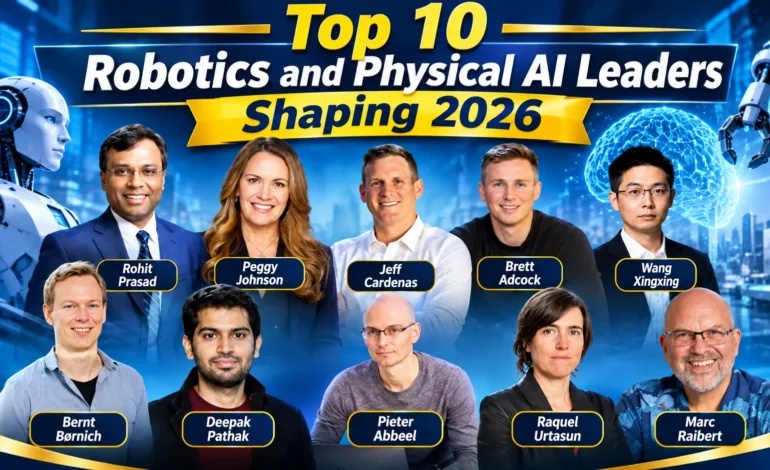
Top 10 Robotics and Physical AI Leaders at a Glance
| No. | Leader | Company or organization | Main area of influence |
| 1 | Rohit Prasad | Boston Dynamics | AI-powered robotics |
| 2 | Peggy Johnson | Agility Robotics | Commercial humanoid robots |
| 3 | Jeff Cardenas | Apptronik | Workplace humanoid robots |
| 4 | Brett Adcock | Figure AI | General-purpose humanoid robots |
| 5 | Wang Xingxing | Unitree Robotics | Accessible advanced robotics |
| 6 | Bernt Børnich | 1X Technologies | Humanoid robots for homes |
| 7 | Deepak Pathak | Skild AI | General-purpose robot intelligence |
| 8 | Pieter Abbeel | UC Berkeley / Amazon | Robot learning and AI research |
| 9 | Raquel Urtasun | Waabi | Autonomous driving technology |
| 10 | Marc Raibert | Robotics & AI Institute | Advanced robot movement |
1. Rohit Prasad: Leading Boston Dynamics Into the Physical AI Era
Role: Chief Executive Officer, Boston Dynamics
Main focus: AI-powered robotics and intelligent machines
Rohit Prasad is one of the notable AI executives bringing artificial intelligence expertise into the robotics industry. In October 2026, Boston Dynamics appointed him as its chief executive officer, placing him at the center of the company’s next phase of development.
Before joining Boston Dynamics, Prasad spent approximately 12 years at Amazon. He became widely recognized for his work on Alexa, Amazon’s voice assistant, and later served as a senior executive overseeing artificial intelligence and artificial general intelligence research.
He also led development of Amazon’s Nova foundation model family. This experience gave him a strong background in building AI products and bringing advanced technology to commercial markets.
His appointment is significant because Boston Dynamics already has considerable experience in mechanical engineering, mobility, and robot control. The company now has an opportunity to combine that expertise with more advanced AI capabilities.
Its portfolio includes three major robotic platforms:
- Spot: A four-legged robot designed for industrial inspections and facility monitoring.
- Stretch: A mobile warehouse robot developed to move boxes and support logistics operations.
- Atlas: An electric humanoid robot platform designed for advanced movement and industrial applications.
Prasad’s challenge is to help transform these technologies into intelligent systems that can perform useful tasks in real-world environments. This requires more than impressive demonstrations. Robots must become reliable, safe, and commercially practical.
His appointment reflects a wider industry trend: robotics companies increasingly need leaders who understand both physical engineering and advanced AI.
2. Peggy Johnson: Scaling Humanoid Robots With Agility Robotics
Role: CEO and Chairperson, Agility Robotics
Main focus: Commercial humanoid robots and workplace automation
Peggy Johnson is the chief executive officer and chairperson of Agility Robotics. She joined the company in March 2024, bringing extensive experience from major technology businesses.
Before joining Agility, Johnson served as CEO of Magic Leap, an augmented reality company. She also held senior leadership positions at Microsoft and Qualcomm, where she worked on technology partnerships, business development, and commercial growth.
Agility Robotics is developing Digit, a humanoid robot designed to perform practical tasks in workplace environments. Its main applications include warehouse operations, logistics, and material handling.
Digit is designed to move through spaces built for people. It can walk, carry objects, and perform repetitive physical tasks that may otherwise require human workers.
The company’s strategy focuses on solving specific workplace problems rather than building robots solely for demonstrations. This distinction matters because businesses need automation that delivers measurable improvements in productivity, safety, and operational efficiency.
Agility has been developing relationships with commercial customers to bring Digit into real working environments. These deployments help the company understand the practical challenges of operating humanoid robots outside research laboratories.
Johnson’s commercial and technology leadership is important as Agility works to move humanoid robotics from development toward wider adoption.
3. Jeff Cardenas: Building Apollo With Apptronik
Role: Co-founder and CEO, Apptronik
Main focus: Humanoid robots for factories and workplaces
Jeff Cardenas is the co-founder and CEO of Apptronik, a robotics company developing humanoid robots for human-centered environments.
The company’s best-known platform is Apollo, a humanoid robot designed to support work in factories, warehouses, and other commercial settings.
Apptronik grew out of robotics research at the University of Texas at Austin. Its development combines mechanical engineering, robotics research, and commercial product strategy.
Cardenas brings experience in technology commercialization and entrepreneurship. Before helping build Apptronik, he worked with innovators and technology businesses through the university’s commercialization ecosystem.
Apollo is designed to operate in environments where human workers already perform physical tasks. Its human-like structure could make it easier to adapt to existing workplaces without completely redesigning facilities.
The company is particularly interested in repetitive and physically demanding activities. These include moving materials, handling objects, and supporting manufacturing operations.
Apptronik has also attracted attention through partnerships and investment aimed at accelerating humanoid robot development. Its progress reflects growing interest from manufacturers seeking alternatives to traditional industrial automation.
However, turning humanoid robots into dependable workplace tools remains a complex challenge. Companies must improve their speed, dexterity, reliability, and ability to work safely alongside people.
Cardenas’ role involves bringing together these engineering and commercial priorities.
4. Brett Adcock: Building General-Purpose Humanoid Robots at Figure AI
Role: Founder and CEO, Figure AI
Main focus: General-purpose humanoid robots
Brett Adcock is the founder and CEO of Figure AI, a company focused on developing general-purpose humanoid robots.
Figure’s central idea is to create robots that can perform a wide range of physical tasks rather than remain limited to one programmed activity. The company aims to develop machines that can understand instructions, recognize objects, and adapt their behavior to changing environments.
Its humanoid platforms are being developed for manufacturing, logistics, warehousing, and potentially household applications.
One important part of Figure’s strategy is combining robotics hardware with advanced AI models. This approach aims to help robots understand spoken instructions, interpret visual information, and respond to situations they have not encountered before.
Figure has also worked on bringing its robots into industrial settings. Its collaboration with BMW attracted attention because it demonstrated the potential use of humanoid machines in automotive manufacturing.
Adcock previously founded companies in technology and aviation. He established Vettery, a recruitment technology company, and later founded Archer Aviation, an electric aircraft business. His experience in building technology companies has helped attract investment and attention to Figure’s ambitious robotics program.
In 2026, Figure remains an important company to watch as the industry works toward more adaptable humanoid systems.
The broader challenge is creating robots that can perform useful tasks consistently rather than simply complete carefully controlled demonstrations.
5. Wang Xingxing: Expanding the Robotics Market With Unitree
Role: Founder and CEO, Unitree Robotics
Main focus: Quadruped and humanoid robots
Wang Xingxing is the founder and CEO of Unitree Robotics, a Chinese robotics company known for developing quadruped and humanoid robots.
He founded Unitree in 2016 after gaining attention for his robotics engineering work. His early projects focused on developing affordable, capable robotic systems that could demonstrate advanced movement and balance.
Unitree has attracted international attention through its relatively accessible robotic platforms. Its products include four-legged robots and humanoid systems designed for research, development, and practical applications.
Its quadruped robots are particularly notable for their ability to walk across different surfaces and maintain balance. The company has also developed humanoid platforms such as the H1 and G1.
Unitree’s work covers several important areas of robotics, including motor control, perception, movement, balance, and coordination. These capabilities are essential for machines expected to operate outside perfectly controlled environments.
The company’s approach is significant because the robotics industry needs more than expensive prototypes. Developers, universities, and businesses also need hardware that is accessible for testing, experimentation, and product development.
Wang’s leadership has helped Unitree become a recognizable name in the global robotics market. Its development of mobile and humanoid platforms makes it an important participant in the expansion of Physical AI.
6. Bernt Børnich: Developing Home Robots at 1X Technologies
Role: Founder and CEO, 1X Technologies
Main focus: Humanoid robots for homes and everyday environments
Bernt Børnich is the founder and CEO of 1X Technologies, a robotics company working toward robots that can operate in everyday human environments.
The company was originally founded as Halodi Robotics in 2014. It later became known as 1X Technologies and expanded its work on humanoid robots.
Its best-known platform is NEO, a humanoid robot designed to assist with everyday household activities. Unlike robots developed exclusively for factories, NEO is intended to operate in homes and interact with people in familiar surroundings.
This presents a different engineering challenge. A home is less predictable than a controlled production line. Furniture, people, pets, and household objects can change position, making navigation and manipulation more difficult.
1X has developed earlier robotic platforms, including EVE, which was designed for enterprise and industrial environments. Its experience with these systems helped inform the company’s move toward consumer-focused robotics.
In 2025, the company introduced NEO and began preparing for early consumer access. In April 2026, 1X announced that its NEO manufacturing facility in California had started full-scale production, marking an important step toward delivering home robots to customers.
Børnich’s work reflects a wider ambition in robotics: creating machines that can safely operate around people and eventually assist with useful everyday activities.
However, reliable home robotics still faces challenges involving safety, cost, dexterity, privacy, and autonomy. A robot that works in a controlled demonstration must prove that it can handle the unpredictable nature of daily life.
7. Deepak Pathak: Building General-Purpose Robot Intelligence at Skild AI
Role: Co-founder and CEO, Skild AI
Main focus: General-purpose artificial intelligence for robots
Deepak Pathak is a robotics researcher and entrepreneur associated with Skild AI, a company developing general-purpose intelligence for robots. He co-founded the company with Abhinav Gupta.
Traditional robots are often designed for specific machines and carefully defined tasks. They may perform repetitive activities very well but struggle when the environment or task changes.
Skild AI is pursuing a different approach. It is developing AI systems intended to help different types of robots learn and perform tasks across environments.
The company’s technology, known as the Skild Brain, aims to provide a shared intelligence layer that can work across different robotic platforms. This could reduce the need to develop completely separate AI systems for every robot and application.
Pathak’s research background includes robot learning and reinforcement learning. These fields explore how machines can improve their behavior through experience, feedback, and interaction with their environments.
The company’s commercial progress has also attracted attention. In September 2026, Skild AI announced that it had crossed $100 million in annual recurring revenue, reporting more than 60 paying customers across several industries.
This development suggests that demand for adaptable robot intelligence is moving beyond research and into commercial applications.
A general-purpose robot intelligence system could eventually support industrial arms, humanoids, and mobile robots without requiring every task to be programmed from scratch.
8. Pieter Abbeel: Advancing Robot Learning and Manipulation
Role: Professor at UC Berkeley and Amazon Scholar
Main focus: Robot learning, artificial intelligence, and manipulation
Pieter Abbeel is a prominent robotics researcher and professor at the University of California, Berkeley. He is also an Amazon Scholar and a co-founder of Covariant, a company that developed AI technology for industrial robotics.
His research focuses on robot learning, artificial intelligence, and manipulation. These areas help robots understand how to interact with physical objects and perform complex tasks.
For example, picking up a fragile item requires more than identifying it through a camera. A robot must estimate its position, select an appropriate grip, apply the right amount of force, and adjust when something goes wrong.
Abbeel has contributed to research exploring how robots can learn complex behaviors through demonstrations, data, and interaction with their surroundings.
He is also involved in Amazon’s frontier AI and robotics research. His work connects academic research with the development of advanced AI systems that could support future robotic applications.
His professional background includes helping establish Covariant, which developed foundation-model technology for warehouse automation and robotic manipulation. His work at the intersection of research and commercial robotics makes him an important figure in the development of intelligent machines.
Manipulation remains one of robotics’ most difficult challenges. Machines may move accurately in controlled settings but still struggle with unfamiliar objects, unexpected changes, and delicate physical tasks.
Abbeel represents the research foundation behind the next generation of intelligent robots.
9. Raquel Urtasun: Bringing Physical AI to Autonomous Transportation
Role: Founder and CEO, Waabi
Main focus: AI-powered autonomous driving and trucking
Raquel Urtasun is the founder and CEO of Waabi, a company developing AI technology for autonomous transportation, particularly self-driving trucks.
Her work demonstrates that Physical AI extends beyond humanoid robots. Autonomous trucks must interpret roads, recognize objects, predict the behavior of other vehicles, and make decisions in changing conditions.
Urtasun has a strong background in computer vision and machine learning. Before founding Waabi in 2021, she was widely recognized for her research in autonomous driving and perception systems.
Waabi uses artificial intelligence and simulation to develop autonomous driving technology. Simulation allows developers to test systems across many driving situations before relying on real-world testing.
This approach is important because autonomous trucks encounter a wide range of conditions. Weather, road construction, traffic, pedestrians, and unexpected obstacles can all affect driving decisions.
Waabi’s technology aims to help autonomous vehicles understand complex environments and make safe decisions. The company has also developed partnerships with major transportation and automotive businesses as it works toward commercial deployment.
Urtasun’s work is relevant to the broader robotics industry because autonomous vehicles face many of the same challenges as mobile robots: sensing, planning, decision-making, and safe interaction with the physical world.
Her leadership shows how AI-driven mobility is an important part of the Physical AI movement.
10. Marc Raibert: A Pioneer in Advanced Robot Movement
Role: Founder and Executive Director, Robotics & AI Institute
Main focus: Advanced robot movement and intelligent machines
Marc Raibert is one of the most influential figures in modern legged robotics. He founded Boston Dynamics in 1992 and helped establish the foundations for robots capable of dynamic movement.
Boston Dynamics became widely known for machines such as Spot, Atlas, and its earlier research robots. These systems demonstrated advances in balance, mobility, and movement over challenging terrain.
Raibert’s research helped show that robots could do more than move through simple, controlled environments. They could balance dynamically, recover from disturbances, and navigate surfaces that would challenge conventional machines.
After leading Boston Dynamics for many years, he founded the Robotics & AI Institute. He currently serves as its founder and executive director.
The institute focuses on advancing robotics and artificial intelligence through research into movement, perception, control, and intelligent machines.
Raibert’s contributions are especially important because movement is a fundamental robotics challenge. A robot must maintain balance, respond to physical forces, and adjust its actions when the environment changes.
Modern AI models can help robots understand instructions and surroundings, but reliable physical movement still requires sophisticated engineering and control systems.
Raibert’s work represents the connection between decades of robotics research and the newer Physical AI era.
Final Thoughts
The robotics industry in 2026 is being shaped by a combination of experienced researchers, technology executives, and ambitious founders.
Leaders such as Rohit Prasad, Peggy Johnson, Jeff Cardenas, Brett Adcock, and Wang Xingxing are helping develop and commercialize new robotic platforms. Bernt Børnich is working toward bringing humanoid robots into homes, while Deepak Pathak and Pieter Abbeel are advancing the intelligence behind these machines.
Raquel Urtasun is applying similar AI capabilities to autonomous transportation, and Marc Raibert continues to influence the research behind advanced robot movement.
Their work shows that the future of robotics is not limited to humanoid machines. It also includes autonomous vehicles, industrial automation, mobile robots, and intelligent systems that interact with the world.
Physical AI is still developing, but its direction is becoming clearer: machines are moving from simply following instructions toward understanding environments and performing increasingly complex tasks.
The next major breakthrough may not come from one company or one robot. It may come from combining better hardware, smarter AI models, improved sensors, and reliable real-world deployment.
Frequently Asked Questions
1. What is Physical AI?
Physical AI refers to artificial intelligence systems that operate in and interact with the physical world. It combines AI models with sensors, actuators, and control systems so machines can perceive their surroundings, make decisions, and take action.
2. Who are the leading robotics and Physical AI leaders in 2026?
Notable leaders include Rohit Prasad, Peggy Johnson, Jeff Cardenas, Brett Adcock, Wang Xingxing, Bernt Børnich, Deepak Pathak, Pieter Abbeel, Raquel Urtasun, and Marc Raibert.
3. Which companies are leading humanoid robotics in 2026?
Companies such as Figure AI, Agility Robotics, Apptronik, Unitree Robotics, and 1X Technologies are developing humanoid robots for industrial, commercial, research, and household applications.
4. What does Brett Adcock do?
Brett Adcock is the founder and CEO of Figure AI, a company developing general-purpose humanoid robots for workplaces and other environments.
5. Who is the CEO of Boston Dynamics in 2026?
Rohit Prasad became Boston Dynamics’ chief executive officer in October 2026. He previously held senior AI leadership positions at Amazon.
6. What is Agility Robotics known for?
Agility Robotics is known for Digit, a humanoid robot designed for workplace and logistics applications, including material handling and warehouse operations.
7. What is the role of AI in robotics?
AI helps robots interpret sensory information, understand instructions, plan movements, recognize objects, and respond to changing environments. It can make machines more adaptable than traditional systems that follow fixed instructions.
8. Can Physical AI robots work in homes?
Some companies, including 1X Technologies, are developing robots for household applications. However, reliable and affordable general-purpose home assistance remains a major engineering challenge.
9. Is autonomous driving part of Physical AI?
Yes. Autonomous vehicles use AI to perceive their surroundings, recognize road conditions, predict the behavior of other vehicles, and make decisions in real time.
10. What is the future of Physical AI?
Physical AI is expected to expand across manufacturing, logistics, transportation, healthcare, and potentially household assistance. Its growth will depend on improvements in safety, reliability, affordability, and real-world performance.
Find this list interesting? Magazines Insights brings readers more stories on the founders shaping the tech future.