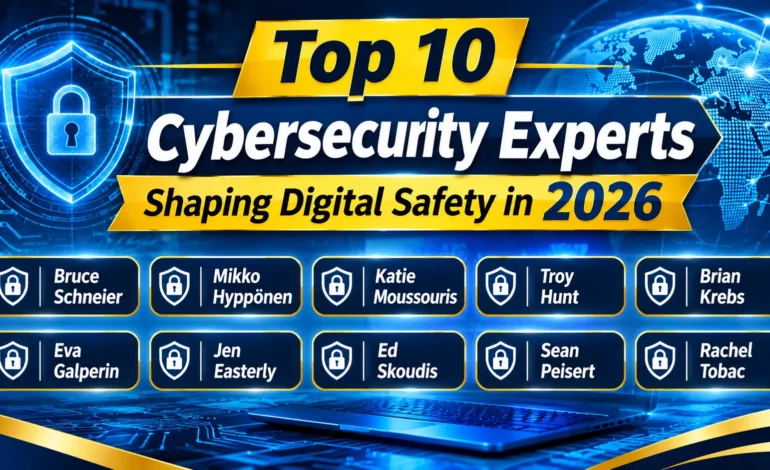
Top 10 Cybersecurity Experts Shaping Digital Safety in 2026
Cybersecurity has become one of the most important priorities in today’s connected world. Businesses, governments, and individuals rely on digital systems for communication, payments, healthcare, education, and everyday activities.
However, greater connectivity also creates new security risks. Ransomware, phishing, identity theft, data breaches, artificial intelligence-powered scams, and sophisticated cyberattacks continue to challenge digital safety.
Behind many improvements in cybersecurity are researchers, investigators, educators, and industry leaders. Their work helps organizations identify threats, protect sensitive information, improve software security, and develop stronger digital policies.
In 2026, cybersecurity expertise covers more than traditional network protection. It also includes artificial intelligence security, vulnerability research, digital privacy, critical infrastructure, and the human behavior behind social engineering attacks.
This article highlights ten cybersecurity professionals whose work has influenced different areas of digital safety. The selection considers their professional contributions, public impact, research, leadership, and educational work. It is an editorial list, not an official global ranking.
Cybersecurity Experts Shaping Digital Safety in Modern World
1. Bruce Schneier – Cryptography, Security Technology, and Digital Privacy
Bruce Schneier is one of the most widely recognized names in cybersecurity, cryptography, and digital privacy. He has spent decades explaining complex security problems to technical professionals, policymakers, and general audiences.
He is an internationally recognized security technologist, author, and lecturer. His professional work connects computer security with public policy, privacy, and the social consequences of technology.
Schneier is a fellow at Harvard University’s Berkman Klein Center for Internet & Society and a lecturer in public policy at the Harvard Kennedy School. He also serves as Chief of Security Architecture at Inrupt.
His books explore cryptography, surveillance, privacy, and the relationship between technology and society. His blog, Schneier on Security, is another important platform for discussing security developments.
One reason his work remains relevant is its broad perspective. He does not treat cybersecurity as a purely technical problem. He also examines how security decisions affect democracy, personal freedom, businesses, and public institutions.
His writing helps readers understand why effective digital protection requires both sound technology and responsible decision-making.
2. Mikko Hyppönen – Malware Research and Threat Intelligence
Mikko Hyppönen is a Finnish cybersecurity researcher known for investigating malware, computer viruses, and evolving digital threats.
His career spans several decades of studying malicious software and the people behind cyberattacks. He has helped explain how malware spreads, how cybercriminals operate, and how digital threats change over time.
Hyppönen has held senior research positions in the cybersecurity industry. His professional biography identifies him as Chief Research Officer at WithSecure and Principal Research Advisor at F-Secure.
He is also a frequent speaker at international technology and security conferences. His presentations make complicated security issues easier for general audiences to understand.
His work is particularly relevant as attackers use increasingly sophisticated techniques. Malware research helps security teams recognize malicious behavior, investigate infections, and develop better defensive tools.
Hyppönen’s contribution extends beyond identifying individual viruses. His research and public communication have helped people understand the wider history and changing nature of cybercrime.
3. Katie Moussouris – Vulnerability Disclosure and Bug Bounty Programs
Katie Moussouris is a cybersecurity entrepreneur and vulnerability disclosure specialist. She is widely recognized for helping organizations develop responsible processes for identifying and reporting software vulnerabilities.
She founded Luta Security, a company that creates and manages vulnerability disclosure and bug bounty programs.
Moussouris played an important role in developing Microsoft’s early bug bounty initiatives. She also led the launch of the U.S. government’s first public bug bounty program, known as Hack the Pentagon.
Bug bounty programs allow organizations to invite security researchers to identify weaknesses under clearly defined rules. Researchers can report vulnerabilities so companies have an opportunity to fix them before malicious attackers exploit them.
Her work also extends to international security standards. She co-authored and co-edited ISO standards covering vulnerability disclosure and vulnerability handling.
This contribution is important because finding a software weakness is only one part of cybersecurity. Organizations also need reliable procedures for receiving reports, assessing risks, communicating with researchers, and fixing problems.
Moussouris has helped make responsible vulnerability reporting a more structured part of modern software security.
4. Troy Hunt – Data Breach Awareness and Have I Been Pwned
Troy Hunt is an Australian web security researcher, software developer, and educator. He is best known as the creator of Have I Been Pwned, a service that helps people check whether their email addresses have appeared in known data breaches.
Launched in 2013, the platform makes breach information easier for individuals and organizations to access.
People can use the service to check whether an email address appears in exposed records. This information can help users recognize compromised accounts and take protective steps, such as changing passwords and enabling multifactor authentication.
Hunt also writes and speaks about web application security, password protection, software development, and data breaches.
His educational work is valuable because data breaches are not only technical incidents. They can expose personal information, create opportunities for identity theft, and increase the risk of account takeovers.
By making breach information more accessible, Hunt has helped turn a complicated security issue into something ordinary internet users can understand and act upon.
5. Brian Krebs – Investigative Cybercrime Journalism
Brian Krebs is an American investigative journalist specializing in cybercrime and online security.
He operates KrebsOnSecurity, an independent publication that investigates data breaches, ransomware, online fraud, cybercriminal networks, and digital threats.
Krebs previously worked as a reporter for The Washington Post. His interest in cybersecurity grew after his own computer network was compromised, leading him to investigate the people and organizations behind online attacks.
His reporting often goes beyond describing a security incident. He examines how criminal networks operate, how stolen information is traded, and how cybercriminals target businesses and individuals.
Krebs has covered major data breaches and online criminal operations. His work has also helped expose the infrastructure and individuals supporting cybercrime.
Although investigative journalism differs from technical security research, it plays an important role in digital safety. Reporting can reveal criminal activity, inform the public, and encourage organizations to take security problems seriously.
Krebs demonstrates how independent journalism can contribute to cybersecurity awareness and accountability.
6. Eva Galperin – Digital Privacy and Anti-Spyware Advocacy
Eva Galperin is a cybersecurity and digital privacy specialist associated with the Electronic Frontier Foundation (EFF).
She serves as EFF’s Director of Cybersecurity. Her work focuses on improving privacy and security for vulnerable populations, including journalists, activists, and people facing targeted digital surveillance.
Galperin is particularly recognized for researching stalkerware. These applications can be misused to monitor another person’s phone activity, location, messages, and other private information without meaningful consent.
She has worked to address the digital security challenges faced by survivors of technology-enabled abuse. She is also a founding member of the Coalition Against Stalkerware, which brings organizations together to address the misuse of surveillance software.
Her work highlights a part of cybersecurity that can receive less attention than corporate network protection.
For many people, digital safety is also about preventing unauthorized monitoring, protecting private communications, and maintaining control over personal information.
Galperin’s advocacy helps connect cybersecurity with human rights, personal privacy, and individual safety.
7. Jen Easterly – National Cybersecurity Strategy and Resilience
Jen Easterly is a prominent cybersecurity and national security leader. She previously served as director of the U.S. Cybersecurity and Infrastructure Security Agency (CISA).
During her leadership at CISA, she focused on strengthening the security and resilience of critical infrastructure. This included encouraging cooperation between government agencies, private companies, and cybersecurity professionals.
Easterly also has experience in military intelligence, national security, and financial-sector resilience. Her career connects cybersecurity with broader questions about public safety and national preparedness.
As of 2026, she serves as CEO of RSAC, the organization behind RSA Conference and its wider professional community. Her current position is listed in the official RSAC leadership profile.
Her work emphasizes that cybersecurity cannot be handled by individual organizations in isolation. Governments, technology companies, financial institutions, and infrastructure operators must coordinate their efforts.
This approach is particularly important when cyberattacks threaten essential services such as energy, healthcare, transportation, and communications.
Easterly’s influence comes from connecting technical security with policy, leadership, and national resilience.
8. Ed Skoudis – Ethical Hacking and Cybersecurity Education
Ed Skoudis is a cybersecurity educator and practitioner recognized for his work in penetration testing, offensive security, and incident response training.
He serves as president of the SANS Technology Institute and is a SANS Fellow. He also founded Counter Hack, a company associated with cybersecurity consulting and cyber range development.
Skoudis helped develop well-known SANS training courses, including SEC504: Hacker Tools, Techniques, and Incident Handling and SEC560: Enterprise Penetration Testing.
These programs teach security professionals how attackers operate and how organizations can identify weaknesses in their systems.
He also helped develop practical training environments such as NetWars and the SANS Holiday Hack Challenge. These environments allow learners to practice security skills in controlled settings.
His contribution received additional recognition in October 2026. SANS announced that Skoudis had been named to the Cyber Security Hall of Fame’s Class of 2026 in the cybersecurity educator and practitioner category.
The announcement recognizes his long-term contribution to professional cybersecurity training. The induction ceremony is scheduled for December 10, 2026, so he has been selected for the class but has not yet been formally inducted as of November 23.
Skoudis’s work demonstrates why cybersecurity education needs practical experience. Professionals must understand how attacks happen before they can build effective defenses.
9. Sean Peisert – Cybersecurity Research and Critical Infrastructure
Dr. Sean Peisert is a cybersecurity researcher associated with Lawrence Berkeley National Laboratory and the University of California, Davis.
He is a senior scientist at Lawrence Berkeley National Laboratory, where he leads computer security research and development. He also serves as an adjunct professor at UC Davis and directs Trusted CI, the National Science Foundation’s Cybersecurity Center of Excellence.
His research covers computer security, privacy, secure scientific data analysis, and the protection of research infrastructure.
Peisert’s work is particularly relevant to systems where a security failure could have consequences beyond an individual business.
These environments include high-performance computing systems, scientific research networks, power grids, and maritime control systems.
Protecting such infrastructure requires specialized knowledge. Security teams must consider operational reliability, sensitive information, interconnected equipment, and the consequences of system disruption.
Peisert’s research contributes to developing security approaches that support both scientific progress and infrastructure protection.
His work shows why cybersecurity research remains essential to industries and institutions that depend on complex digital systems.
10. Rachel Tobac – Social Engineering and Human-Centered Security
Rachel Tobac is a cybersecurity entrepreneur, hacker, and social engineering specialist.
She is the CEO of SocialProof Security, an organization that helps businesses and individuals understand and defend against social engineering attacks.
Social engineering involves manipulating people into revealing sensitive information or performing actions that compromise security.
Attackers may impersonate employees, executives, technical support representatives, or trusted organizations. They often use urgency, authority, and convincing communication to influence their targets.
Tobac is known for demonstrating how these attacks work and explaining why even technically secure organizations can be vulnerable to human manipulation.
Her work includes security training and penetration testing focused on social engineering risks.
She has also spoken publicly about these threats and appeared in media coverage to explain how attackers exploit trust and everyday communication habits.
Her work highlights an important lesson: cybersecurity is not only about firewalls, software, and encryption. People also need to recognize suspicious requests and understand how manipulation techniques operate.
What Makes These Cybersecurity Experts Influential in 2026?
The ten professionals on this list work in different areas, but their contributions share several important themes.
They Help Organizations Understand Emerging Threats
Researchers such as Mikko Hyppönen investigate malware and changing attack techniques. Their work helps security teams recognize threats and improve defensive strategies.
They Encourage Responsible Software Security
Katie Moussouris has helped develop vulnerability disclosure and bug bounty practices. These processes give organizations structured ways to identify and address software weaknesses.
They Make Cybersecurity More Accessible
Troy Hunt and Bruce Schneier explain complicated security issues to wider audiences. Their work helps individuals and organizations make more informed decisions about digital protection.
They Expose Cybercrime and Online Abuse
Brian Krebs investigates criminal networks, while Eva Galperin focuses on spyware, surveillance, and the safety of vulnerable individuals.
They Strengthen Leadership, Education, and Research
Jen Easterly contributes through cybersecurity leadership and policy. Ed Skoudis develops professional training, while Sean Peisert advances research into secure computing and critical infrastructure.
They Address the Human Side of Cybersecurity
Rachel Tobac demonstrates how attackers manipulate people rather than simply exploiting technical weaknesses. Her work reinforces the importance of awareness and practical security training.
Final Thoughts
The cybersecurity experts shaping digital safety in 2026 come from different professional backgrounds. Some investigate malware and cybercrime, while others improve software security, protect privacy, lead public institutions, or educate future professionals.
Bruce Schneier and Mikko Hyppönen contribute through security research and public education. Katie Moussouris advances responsible vulnerability disclosure, while Troy Hunt makes breach information accessible to ordinary users.
Brian Krebs investigates cybercriminal networks, and Eva Galperin focuses on digital privacy and personal safety. Jen Easterly contributes through leadership and cyber resilience, while Ed Skoudis strengthens professional training.
Sean Peisert advances research into secure computing and critical infrastructure. Rachel Tobac helps organizations understand the human risks behind social engineering.
Together, their work illustrates that digital safety requires more than advanced software. It depends on informed users, responsible organizations, effective policies, technical research, and continuous education.
As cyber threats continue to evolve, professionals working across these areas will remain important to protecting individuals, businesses, governments, and critical infrastructure.
Frequently Asked Questions
1. Who are the top cybersecurity experts in 2026?
Notable cybersecurity professionals include Bruce Schneier, Mikko Hyppönen, Katie Moussouris, Troy Hunt, Brian Krebs, Eva Galperin, Jen Easterly, Ed Skoudis, Sean Peisert, and Rachel Tobac. They contribute through research, privacy advocacy, leadership, education, and cybercrime investigation.
2. Who is the most influential cybersecurity expert?
There is no universally accepted number-one cybersecurity expert. Influence depends on the area being considered, including technical research, security leadership, public education, vulnerability research, and privacy advocacy.
3. What does Bruce Schneier specialize in?
Bruce Schneier specializes in security technology, cryptography, digital privacy, surveillance, and technology policy. He is also known for his books and cybersecurity commentary.
4. Who created Have I Been Pwned?
Australian cybersecurity researcher Troy Hunt created Have I Been Pwned in 2013. The service helps users check whether their email addresses have appeared in known data breaches.
5. What is Katie Moussouris known for?
Katie Moussouris is known for vulnerability disclosure programs, bug bounty initiatives, and software security policy. She helped establish Microsoft’s early bug bounty program and led the U.S. government’s Hack the Pentagon initiative.
6. Who is Mikko Hyppönen?
Mikko Hyppönen is a Finnish cybersecurity researcher recognized for his work investigating malware, computer viruses, and digital threats. He has also held senior research positions in the cybersecurity industry.
7. What does Brian Krebs investigate?
Brian Krebs investigates cybercrime, ransomware, online fraud, data breaches, and criminal networks. He publishes his reporting through KrebsOnSecurity.
8. Who is Eva Galperin?
Eva Galperin is the Director of Cybersecurity at the Electronic Frontier Foundation. Her work focuses on digital privacy, spyware, stalkerware, and protecting vulnerable people from targeted surveillance.
9. What is Jen Easterly known for?
Jen Easterly is known for her cybersecurity leadership and former position as director of CISA. In 2026, she serves as CEO of RSAC.
10. Who is Ed Skoudis?
Ed Skoudis is a cybersecurity educator and practitioner known for penetration testing, incident response, and SANS training programs. He was named to the Cyber Security Hall of Fame’s Class of 2026.
11. What does Sean Peisert research?
Sean Peisert researches computer security, privacy, secure scientific data analysis, and critical infrastructure protection. His work includes high-performance computing, power grids, and research networks.
12. Who is Rachel Tobac?
Rachel Tobac is a cybersecurity entrepreneur and social engineering specialist. She leads SocialProof Security, which helps organizations understand and defend against human-focused attacks.
13. Why are cybersecurity experts important in 2026?
Cybersecurity experts help organizations identify emerging threats, improve digital defenses, protect sensitive information, and respond to attacks. Their work also supports safer technology, stronger policies, and better public awareness.
14. Which cybersecurity experts focus on digital privacy?
Bruce Schneier and Eva Galperin are notable voices in digital privacy, although their work addresses different areas. Schneier examines security and privacy at a broader technological and policy level, while Galperin focuses on protecting vulnerable people from spyware and surveillance.
15. How can beginners learn cybersecurity from experts?
Beginners can follow expert blogs, watch security conference presentations, study networking fundamentals, and use authorized cybersecurity training labs. They should also learn basic topics such as password security, phishing awareness, operating systems, and responsible vulnerability reporting.
Find this list interesting? Magazines Insights brings readers more stories on the founders shaping the tech future.