Research Dossier for Target Company: A Complete Guide to Business Research
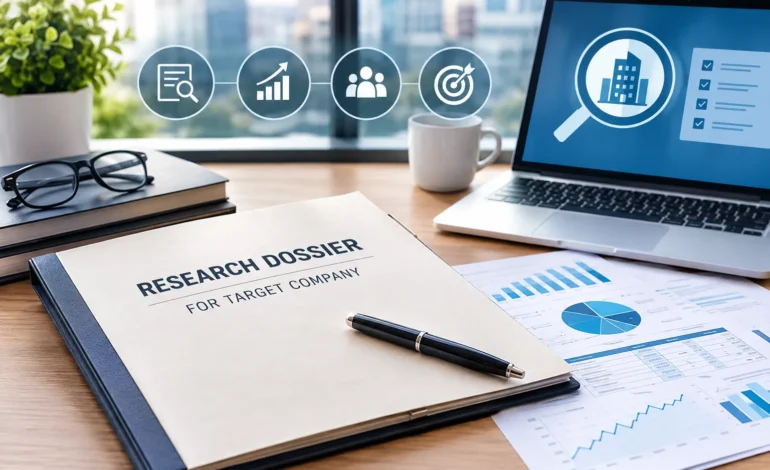
A research dossier for target company is a structured document that brings this information together in one place. It helps business professionals move beyond scattered facts and make better-informed decisions.
Whether you work in sales, marketing, consulting, investment research, procurement, or business development, a well-prepared dossier can help you identify opportunities, prepare meaningful questions, and recognize warning signs before committing time or money.
In this guide, you will learn what a company research dossier includes, why it matters, how to prepare one step by step, which sources to use, and how to create a reusable template for future research projects.
What Is a Research Dossier for a Target Company?
A research dossier for a target company is an organized report containing relevant information and analysis about a specific business. It combines company records, financial information, market research, leadership details, competitive intelligence, recent developments, and risk indicators.
The term “target company” refers to the business being investigated. It does not necessarily mean Target Corporation, the American retail chain.
The purpose of the dossier depends on the research objective. A salesperson may want to understand a prospective client’s business needs, while an investor may focus on financial performance and potential risks. A procurement manager may be more interested in supplier reliability, ownership, and operational capabilities.
A useful dossier typically answers five questions:
- What does the company do, and how does it make money?
- Who owns the business and makes important decisions?
- How does the company compare with its competitors?
- What opportunities and risks could affect the business?
- What should the researcher or organization do next?
The goal is not to collect every available fact. It is to gather the information that matters most to a specific business decision.
Why Is a Target Company Research Dossier Important?
Business decisions often involve uncertainty. A company may have an attractive website, an impressive product portfolio, or a promising reputation, but these details alone do not establish whether it is the right partner, customer, supplier, or investment opportunity.
A research dossier helps organize evidence so that decision-makers can evaluate the company more carefully.
1. It Supports Better Business Decisions
A structured report makes it easier to compare a company’s strengths, weaknesses, opportunities, and risks. Instead of relying on assumptions or a single source, you can review several types of evidence before deciding how to proceed.
For example, a business considering a partnership might discover that the potential partner offers complementary services but operates in markets that do not match its own growth plans. That finding could lead to a more focused partnership discussion or a decision to explore other options.
2. It Improves Sales Prospecting
Sales professionals can use company research to understand a prospect’s products, customers, business model, recent announcements, and likely priorities.
This information helps them prepare relevant outreach instead of sending generic messages. If a company has publicly announced an expansion, for instance, a salesperson might investigate whether that development creates a need for additional software, marketing services, or operational support.
The research should identify a reasonable business opportunity rather than assume the company has a problem it has not disclosed.
3. It Helps Identify Competitive Opportunities
A company dossier can reveal how a business positions itself in the market, which customer groups it serves, and what distinguishes its products or services.
The U.S. Small Business Administration recommends examining factors such as market share, competitor strengths and weaknesses, barriers to entry, and indirect competition when conducting competitive analysis. These factors can also help organize the market section of a target company dossier.
4. It Helps Highlight Potential Risks
A company’s public information may reveal concerns that deserve further investigation. Examples include declining reported revenue, leadership turnover, regulatory issues, customer concentration, or repeated delays in delivering products.
Not every negative signal indicates a serious problem. A leadership change may reflect planned succession, and a legal dispute does not automatically establish wrongdoing. Researchers should verify the underlying facts and explain their possible significance without jumping to conclusions.
5. It Makes Research Easier to Share
When research is stored in a consistent format, colleagues can review the findings without repeating the entire process.
A sales team can use the dossier before a client meeting. A management team can compare potential suppliers. An investment team can use it to identify questions for a more detailed review.
A well-organized dossier also records source links and research dates, making it easier to check whether the information remains accurate.
What Information Should a Research Dossier for Target Company Include?
The structure should reflect the reason for researching the business. However, most dossiers benefit from the following core sections.
1. Company Overview
Begin with a concise snapshot of the organization. This section should establish which company you are researching and provide enough background for readers to understand the business.
Include:
- Official company name and website
- Legal entity name, where available
- Headquarters and main operating locations
- Founding year, if verified
- Industry and business category
- Ownership type, such as public or private
- Parent company and subsidiaries, where relevant
- Main products and services
- Primary customer groups
- Geographic markets served
Confirm the company’s identity before collecting additional information. Businesses can share similar names, operate under different trading names, or belong to larger corporate groups. Mixing information from two entities can undermine the entire report.
2. Business Model and Products
The next section explains how the company operates and generates revenue.
Investigate its principal products or services, pricing approach, distribution channels, customer segments, and revenue streams. For a software company, this might include subscription plans, enterprise contracts, and implementation services. For a manufacturer, the focus may be on product categories, distribution networks, and major customer industries.
Questions to consider include:
- What does the company sell?
- Who typically buys its products or services?
- How does it charge customers?
- What differentiates its main offerings?
- Does it rely on recurring contracts, one-time sales, licensing, or another revenue model?
- Are there important dependencies on suppliers, distributors, or technology providers?
Use company materials to understand its stated business model, then compare those claims with available independent evidence.
3. Leadership and Ownership
Understanding who controls a business and who makes important decisions can be essential for sales, investment research, acquisitions, and partnership planning.
Record relevant executives, founders, board members, major owners, and parent organizations when reliable information is available. Include their roles and the dates of important leadership changes.
For a sales dossier, the most relevant people may be the department heads responsible for purchasing decisions. For investment research, ownership structure and board oversight may deserve more attention.
Do not assume that a person has decision-making authority simply because of their job title. Confirm responsibilities through company announcements, official biographies, professional profiles, or other reliable sources.
4. Financial Performance
Financial research helps establish the company’s reported performance and provides context for assessing its stability and growth.
For publicly traded companies, review available annual reports, quarterly reports, financial statements, and other regulatory disclosures. In the United States, the Securities and Exchange Commission’s EDGAR database provides free public access to company filings and related documents:
Depending on the company and research objective, examine:
- Revenue trends
- Operating income and net income
- Cash flow
- Cash reserves and debt
- Major business segments
- Capital expenditures
- Funding history and publicly disclosed investments
- Financial risks identified by management
Compare figures across consistent reporting periods. Revenue from one fiscal year should not be compared casually with a quarterly figure from another period.
Private companies may disclose less financial information than public companies. If reliable figures are unavailable, record the information gap rather than inventing revenue estimates or presenting speculation as fact.
5. Market Position and Competitors
A company does not operate in isolation. Its performance depends partly on customer demand, industry conditions, competitors, pricing pressure, and barriers to entry.
Identify the company’s direct competitors and, where relevant, indirect alternatives. Then compare the businesses using criteria that matter to the research objective.
| Comparison factor | What to investigate |
| Products and services | Similarities, differences, and product coverage |
| Target customers | Industries, company sizes, and customer segments |
| Pricing | Publicly available pricing and commercial models |
| Market positioning | Main value proposition and brand positioning |
| Distribution | Sales channels, locations, and geographic reach |
| Strengths | Verified capabilities and competitive advantages |
| Challenges | Documented limitations or areas requiring further research |
Avoid declaring a company the market leader unless credible evidence supports that conclusion. Marketing statements, search rankings, and social media popularity do not independently prove market share.
The objective is to understand where the target company fits within its market and which competitive factors could influence the decision at hand.
6. Customers and Business Relationships
Customer information can help researchers understand the company’s commercial relationships and target market.
Review published case studies, customer testimonials, partnership announcements, and references in credible industry publications. Record the source and date for each significant claim.
Useful questions include:
- Which customer industries does the company serve?
- Does it publish verified customer case studies?
- What business problems do its products address?
- Does it depend heavily on a small number of customers?
- Which suppliers, distributors, or partners appear important to its operations?
Distinguish between a company claiming to serve a particular customer and an independently verified relationship. Customer logos on a website, for example, may not explain the scope or current status of a relationship.
Do not attempt to obtain confidential customer lists or private information through unauthorized means.
7. Recent Developments and Strategic Priorities
A company’s recent activities can be especially valuable because older information may no longer reflect its current direction.
Review relevant announcements from a defined period, such as the past 6 to 12 months. The appropriate window depends on the industry and the decision being considered.
Look for:
- New products and services
- Acquisitions or partnerships
- Leadership appointments and departures
- New offices or market expansion
- Funding announcements
- Major contracts
- Layoffs or restructuring
- Regulatory developments
- Changes in strategic priorities
Use dated company announcements and credible reporting wherever possible. Record the announcement date separately from the date an event actually occurred if they differ.
For sales teams, these developments may provide relevant reasons to start a conversation. For investors or acquisition teams, they may help identify questions about strategy, execution, and financial exposure.
8. Legal, Regulatory, and Operational Risks
Risk research should examine issues that could affect the company’s ability to operate, meet obligations, or achieve its objectives.
Depending on the business, relevant areas may include litigation, regulatory actions, intellectual property disputes, data security incidents, supply chain dependencies, contractual exposure, and licensing requirements.
For U.S. companies, official records may include SEC filings, relevant state business registries, court records, regulator announcements, and intellectual property databases.
The United States Patent and Trademark Office provides a federal trademark search system that can help researchers investigate trademark applications and registrations:
However, no single database provides a complete picture of a company’s legal or operational position. Search results must be interpreted carefully. An allegation is not the same as a proven violation, and the absence of a result does not establish that no risk exists.
Record each relevant finding with its source, date, status, and potential business implications.
9. Online Reputation and Public Feedback
Customer reviews, employee feedback, industry commentary, and public discussions can reveal themes worth investigating.
Rather than focusing on isolated positive or negative comments, look for recurring patterns. Repeated complaints about delivery delays, support quality, or product reliability may justify further research, but the findings should be checked against other evidence.
Consider:
- Customer review patterns
- Commonly reported service concerns
- Employee feedback trends
- Public responses to complaints
- Relevant industry coverage
- Evidence of improvements or unresolved issues
Reviews are subjective and may not represent the full customer base. Treat them as signals, not definitive proof of company-wide performance.
10. Research Findings and Recommended Next Steps
A dossier should conclude with analysis, not merely a list of facts.
Summarize the most important findings and explain how they relate to the original research objective. Identify the strongest opportunities, the most significant risks, and the questions that remain unanswered.
A useful conclusion may include:
- Three to five important findings
- The strongest evidence supporting the opportunity
- Major concerns requiring clarification
- Information gaps that could change the assessment
- Recommended next steps
- A preliminary recommendation, with its limitations clearly stated
The conclusion should distinguish verified facts from the researcher’s interpretation. If the available evidence is incomplete, say so rather than presenting a confident recommendation without sufficient support.
How to Create a Research Dossier for a Target Company Step by Step
Building a useful dossier is easier when the research process follows a repeatable sequence.
Step 1: Define Your Research Objective
Start by writing one sentence explaining why you are investigating the company.
For example:
“We are researching this software provider to determine whether it is suitable for our organization’s vendor shortlist.”
This statement defines the scope. A supplier assessment will prioritize reliability, service capability, and contractual risks, while an acquisition review will require more detailed financial, legal, ownership, and operational analysis.
Also identify the questions that could change your final decision. This prevents the research from becoming an unfocused collection of company facts.
Step 2: Confirm the Company’s Identity
Verify the legal name, official website, headquarters, operating locations, ownership structure, and relevant subsidiaries.
Check whether the business has changed its name, merged with another organization, or operates through several legal entities. Use official company information and relevant public records whenever possible.
This step is especially important when researching companies with similar names or complex corporate structures.
Step 3: Collect Information From Reliable Sources
Begin with primary sources, including official filings, company reports, regulator records, product documentation, and dated announcements.
Use reputable news organizations, industry publications, and research databases to add context. Social media posts and review platforms can be useful for identifying leads, but important claims should be verified independently.
For every significant finding, save the source link and access date. This makes the report easier to audit and update.
Step 4: Organize the Evidence
Place the information into clearly labeled sections. A spreadsheet can help manage source links, dates, figures, and research notes, while a document can present the findings and recommendations.
A simple evidence table might contain:
| Field | Example entry |
| Research question | What are the company’s main products? |
| Finding | The company sells business software |
| Source | Official product page |
| Date checked | October 28, 2026 |
| Evidence status | Verified from the cited page |
| Business implication | Relevant to the vendor comparison |
The example is illustrative, not a claim about a real company.
Step 5: Analyze Trends and Compare Findings
Once the information is organized, look for patterns. Compare financial performance over consistent periods, assess competitors using the same criteria, and check whether company announcements align with other available evidence.
Consider alternative explanations for unexpected findings. A reduction in employee numbers, for example, might indicate restructuring, seasonal changes, outsourcing, or a shift in business strategy. Do not assign a cause without evidence.
Step 6: Assess Opportunities and Risks
Evaluate the findings against your original objective. Which details make the company a stronger candidate? Which concerns require more investigation? What information is still missing?
You can rank findings by potential impact and evidence quality. This makes it easier for decision-makers to distinguish major concerns from minor observations.
Step 7: Write the Executive Summary
Prepare a short summary after completing the detailed research. Include the company’s basic profile, the most important findings, the main uncertainties, and the recommended next step.
Writing this section last helps ensure that the summary reflects the evidence rather than the assumptions you started with.
Step 8: Verify and Update the Dossier
Before sharing the report, check key names, figures, dates, and quotations against their original sources. Remove unsupported statements and clearly label estimates or unresolved questions.
Add a last-reviewed date to the document. For active sales accounts, investment targets, or suppliers, schedule updates when significant announcements occur and before important decisions or meetings.
Best Sources for Company Research
The quality of a research dossier depends on the quality of its evidence. Use sources according to the information you need, and remember that source availability varies by company, industry, and jurisdiction.
Official Company Websites
Company websites are useful for understanding products, services, leadership, locations, customer segments, and stated business priorities. They are valuable starting points, but promotional claims should not be treated as independent verification.
SEC EDGAR
The SEC’s EDGAR system is an important resource for researching U.S. public companies and other entities that file disclosures with the commission. It provides access to regulatory filings that can contain financial statements, business descriptions, risk factors, and other material information.
Government and Regulatory Records
Depending on the jurisdiction, business registries, court records, regulatory databases, and licensing authorities can help confirm legal identities, filings, and public regulatory actions.
For intellectual property research in the United States, the USPTO provides tools for searching federal trademark records. More complex legal questions may require professional advice.
Credible Business News and Industry Publications
Established business publications can provide context about acquisitions, leadership changes, market developments, and competitive activity. Check publication dates and compare major claims with primary sources when possible.
Company Reports and Investor Presentations
Annual reports, quarterly reports, investor presentations, and earnings-call materials can explain business strategy and reported performance. Remember that management presentations may emphasize favorable aspects of the business, so compare them with financial disclosures and other evidence.
Professional Networks and Review Platforms
Professional profiles may help verify job titles and career histories. Customer and employee review platforms can reveal recurring themes, but their content is often self-reported and should be evaluated cautiously.
No single source should be expected to answer every research question. Combining credible sources creates a more balanced view.
Research Dossier vs. Company Profile vs. Due Diligence
These documents are related, but they serve different purposes.
| Document | Main purpose | Typical depth |
| Company profile | Provide a basic overview of a business | Brief |
| Research dossier | Organize evidence and analysis for a specific decision | Moderate to detailed |
| Due diligence report | Investigate material issues before a significant transaction or commitment | Depends on the transaction; often extensive |
A company profile may explain what a business does and who leads it. A research dossier adds context about its market position, performance, risks, and relevance to a particular objective.
Due diligence goes further when a transaction requires more formal verification. It may involve specialist legal, financial, tax, regulatory, cybersecurity, and operational reviews, along with confidential documents made available through authorized processes.
A research dossier can help identify which questions deserve deeper due diligence, but it is not a substitute for that process.
Common Mistakes to Avoid When Preparing a Company Dossier
Even a detailed report can be misleading if the research process is weak. Avoid these common mistakes.
Relying on a Single Source
Company websites, news reports, and review platforms each have limitations. Verify important claims through appropriate independent or primary sources.
Using Outdated Information
Leadership, pricing, products, ownership, and financial performance can change. Record dates and prioritize information that is current enough for the decision.
Mixing Facts With Assumptions
A statement that the company announced a new product is a factual claim if supported by the announcement. A statement that the product will increase revenue is a prediction unless evidence establishes the outcome.
Keep these categories separate.
Ignoring Negative Evidence
Research should not focus only on information that supports an existing opinion. Investigate credible warning signs and consider evidence that challenges your initial assessment.
Treating Estimates as Confirmed Figures
Private companies may not disclose revenue, valuation, customer numbers, or employee totals. Label estimates clearly, explain their source, and omit them when they cannot be supported.
Collecting Information Without a Clear Purpose
A lengthy dossier is not necessarily a useful one. Prioritize findings that affect the decision, and move less relevant details into an appendix if needed.
Ignoring Privacy and Legal Boundaries
Use lawful, appropriately obtained information. Do not access private accounts, confidential records, or restricted systems without authorization. Public availability also does not automatically mean every use of personal information is appropriate.